Neural-symbolic planner · Salesforce ecosystem
The planning layer that makes Agentforce reliable for complex, multi-step enterprise workflows — deterministic, auditable, production-ready.
MOTA planner · live execution
Architecture
MOTA is not a replacement for Agentforce. It's the deterministic planning and verification layer that sits between your users' intent and Agentforce's execution engine.
Stack · Salesforce ecosystem
No rip-and-replace. MOTA deploys on your infrastructure. Production in weeks, not quarters.
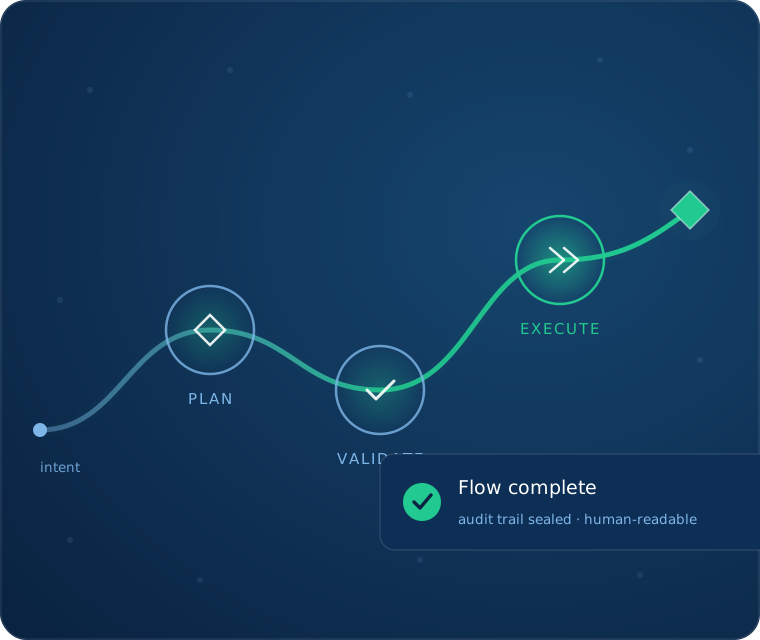
MOTA decomposes intent into a symbolic, rule-validated execution sequence. Each action is verified before execution — not after.
Every decision logged in plain English — not a JSON dump. Satisfies legal, audit, and regulatory requirements without bespoke tooling.
The same planning layer applies to ServiceNow, HubSpot, SAP. MOTA becomes the universal planning layer for enterprise agentic AI.
What the market is saying
Salesforce's own executives, enterprise CIOs, and verified customer reviews tell the same story. These are their exact words.
Production adoption despite 29,000 enterprise deals signed. The gap between "signed" and "in production" is where MOTA operates.
Even low-frequency inaccuracies are unacceptable when responses go directly to customers. The failure mode is "confidently wrong" — which creates reputational and legal exposure.
Our most sophisticated customers are struggling to keep autonomous agents on-topic in critical workflows, where unpredictable behaviour drives up operational risk.
Identical scenarios trigger different execution paths based on how the model interpreted intent that session. Agent behaviour varied from session to session.
One retail enterprise's actual month-one Agentforce bill. They projected $4,000. Nobody modelled the multi-step reasoning chains.
Getting consistent and accurate results isn't as simple as just telling the agent what to do. The learning curve for truly optimising Agentforce is significant.
How it works
MOTA sits between the user's intent and your Agentforce actions — giving the AI structure, rules, and accountability.
MOTA decomposes natural language intent into a structured symbolic execution plan. Each step is validated against your business rules and CRM schema before anything executes.
Each step fires in deterministic sequence — get_account() → check_entitlements() → update_case(). Unexpected results pause and escalate. No silent failures.
Every decision, every API call, every data access — logged in plain English. A human-readable record your compliance and legal teams can actually use.
Execution trace · case resolution
Independent validation
CRMArena-Pro is built by Salesforce AI Research. We publish our full results — judge for yourself.
| Model / System | Single-step | Multi-turn | Multi-step | Audit-ready |
|---|---|---|---|---|
| OpenAI + MOTAMOTA | 91% | 87% | 85% | ✓ Yes |
| Gemini 2.5 Pro | 58% | 35% | 35% | ✕ |
| GPT-4o | 54% | 32% | 32% | ✕ |
| O3 | 56% | 34% | 34% | ✕ |
| DeepSeek | 48% | 28% | 28% | ✕ |
Source: CRMArena-Pro · Salesforce AI Research · arxiv.org/abs/2505.18878 · Download full MOTA results (PDF) →
Early adopter programme
We're working with a small number of Salesforce enterprise customers to deploy MOTA in production. Early adopters get direct access to our founding team — and get to production in weeks, not quarters.
We review every application personally. Response within 48 hours.
Insights
Thinking on neuro-symbolic AI, enterprise agent reliability, and the future of the planning layer.
Salesforce's CRMArena-Pro benchmark reveals a stark gap between what LLMs promise and what they deliver on complex workflows.
LLMs predict the next token. Enterprise workflows need the next verified action. The difference is architectural — and it matters enormously in production.
"Confidently wrong" — Salesforce's own consultants describe what happens when LLM agents hit complex multi-step workflows. Here's the fix.